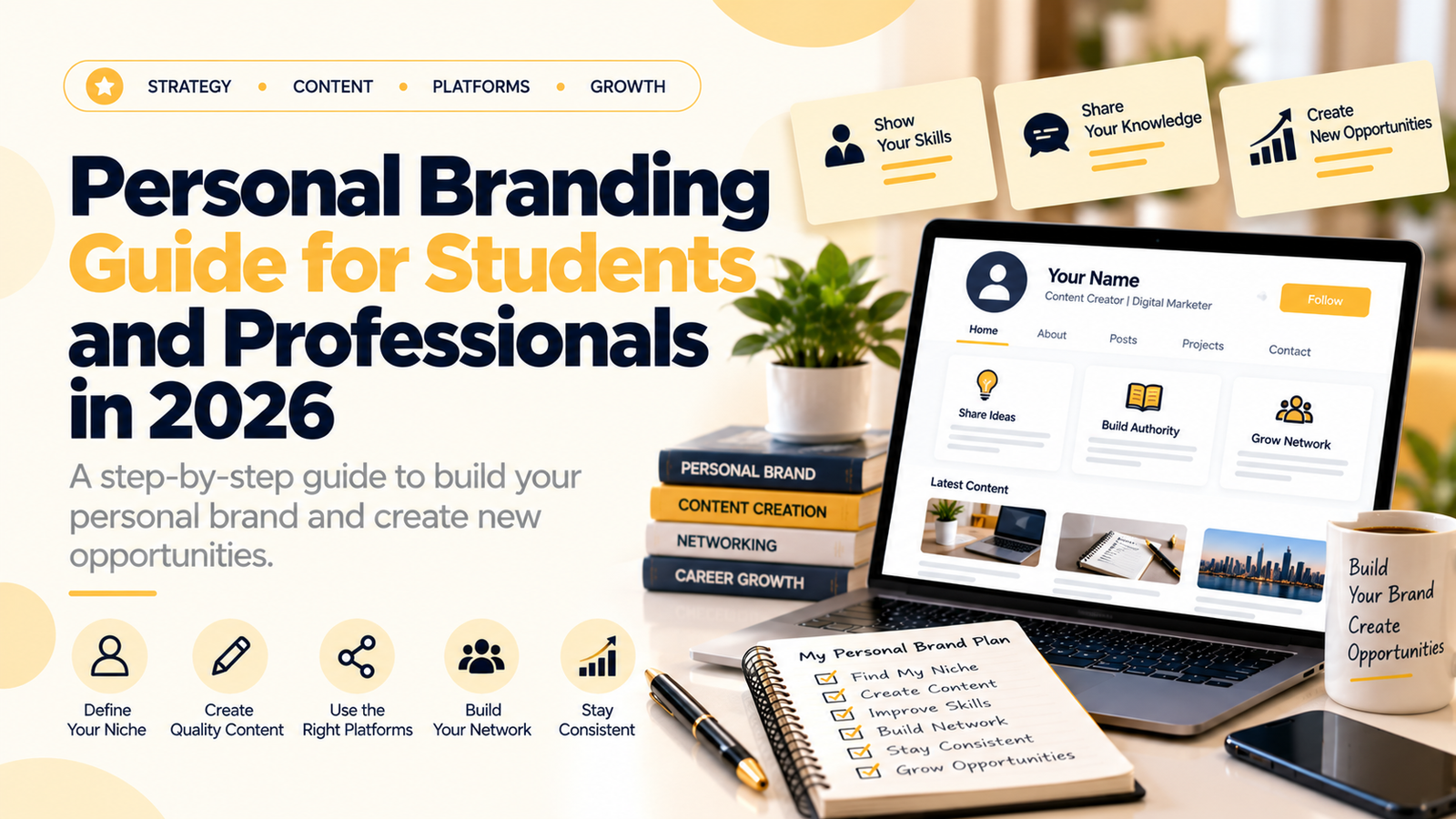
In today’s digital world, your professional identity is not defined only by your degree, job title, or years of experience. The way you communicate, the work you share, the skills you demonstrate, and the reputation you build online can also influence how people perceive you.
This is where personal branding becomes important.
Whether you are a student preparing for your first job, a freelancer searching for clients, a working professional planning career growth, or an entrepreneur building a business, a clear personal brand can help people understand who you are, what you do, and what makes your perspective valuable.
However, personal branding is not simply about posting on social media every day or trying to become famous. It is about developing a credible professional identity and communicating it consistently.
In this guide, you will learn how to build your personal brand in 2026, choose the right platforms, create meaningful content, demonstrate your expertise, and develop professional relationships over time.
1. What Is Personal Branding?
Personal branding is the process of shaping how people understand your professional identity, expertise, values, and work.
Think of it as the combination of three things:
- Your expertise: What you know and what you can do.
- Your reputation: How people experience your work and professional behaviour.
- Your communication: How you explain your ideas, share your knowledge, and present yourself.
For example, a student interested in digital marketing might regularly share practical marketing projects, lessons learned, and thoughtful observations about online businesses.
Over time, this can help others understand the student’s interests and developing capabilities.
Similarly, a freelancer who publishes useful tutorials and presents a strong portfolio may make it easier for potential clients to understand the services they offer.
A personal brand should reflect your real skills and experience. It does not require pretending to be an expert in everything.
2. Define What You Want to Be Known For
Before creating content or updating your social media profiles, decide what you want your professional identity to communicate.
Trying to become known for too many unrelated topics can make your message confusing.
Start by answering these questions:
- What subjects genuinely interest me?
- Which skills am I developing or already able to demonstrate?
- Who would benefit from my knowledge or work?
- What problems can I help solve?
- What kind of professional opportunities do I want to attract?
Your answers can help you identify a central theme for your personal brand.
For example:
- A student might focus on learning technology and sharing practical projects.
- A digital marketer might discuss content strategy, SEO, and campaign analysis.
- A designer might showcase visual communication and design processes.
- A finance professional might explain financial concepts within their qualifications and area of expertise.
- An entrepreneur might share business-building lessons, customer insights, and operational experiences.
You can explore multiple interests, but try to establish a clear primary theme that connects your content.
Your focus may evolve as you gain experience. Personal branding should grow with you rather than permanently restrict your career choices.
3. Identify Your Target Audience
A personal brand becomes more effective when you understand the people you want to reach.
Your audience might include recruiters, potential clients, industry peers, business owners, students, or people interested in learning a particular subject.
Each group looks for different information.
Recruiters may want to understand your skills, projects, qualifications, and professional interests.
Potential clients may want to see examples of your work, the problems you can solve, and how you approach projects.
An educational audience may be more interested in practical explanations, useful resources, and lessons that make difficult subjects easier to understand.
Create a simple audience profile
Write down:
- Who you want to reach.
- What they are trying to achieve.
- Which questions they frequently ask.
- What information would help them.
- Where they are likely to discover your work.
This exercise helps you create relevant content instead of publishing random updates without a clear purpose.
You do not need to appeal to everyone. A smaller, relevant audience can be more useful for your professional goals than a large audience with little connection to your work.
4. Build a Professional Online Presence
Your online profiles often provide the first impression people have of your professional identity.
You do not need to be active on every platform. Begin with one or two that are appropriate for your goals.
LinkedIn for professional visibility
<Entity value=”LinkedIn” category=”software” disambig=”Professional networking platform”/> can help you present your experience, share professional insights, connect with industry peers, and discover relevant opportunities.
Improve your profile by including:
- A clear profile photograph, if you choose to use one.
- A headline that describes your professional focus.
- A concise introduction.
- Relevant skills and qualifications.
- Projects or portfolio links.
- Accurate experience details.
- Contact information where appropriate.
Avoid using vague headlines that reveal little about your work.
Instead of writing only “Student” or “Freelancer,” describe your area of interest and the skills you are developing, without exaggerating your experience.
Instagram and visual platforms
Visual platforms may be useful for designers, video editors, content creators, educators, and businesses whose work benefits from visual demonstration.
Use a consistent presentation style and organise your strongest work so that new visitors can understand your focus quickly.
YouTube and educational content
If you enjoy explaining concepts, demonstrating processes, or discussing industry topics, video content may help you communicate your knowledge in greater depth.
You do not need to start with expensive equipment. Clear explanations, useful information, and consistent improvement matter more than elaborate production.
Your own website or portfolio
A personal website can bring your professional information, portfolio, articles, and contact details together in one place.
It can be especially useful when you want more control over how your work is organised and presented.
Start with the platform that best supports your current goals. You can expand your online presence as your needs develop.
5. Create a Personal Brand Statement
A personal brand statement is a short description of your professional focus and the value you aim to provide.
It helps people understand your direction without reading your entire profile.
A simple structure is:
I focus on [your area] and help or support [your audience] through [your skills, work, or approach].
For example:
“I focus on digital marketing and help small businesses understand content strategy, audience engagement, and online visibility.”
A student might write:
“I am developing my skills in web development and share practical projects and lessons from my learning journey.”
A freelancer might write:
“I create clear, user-friendly websites for small businesses and independent professionals.”
These are examples rather than templates you must copy. Your statement should reflect your actual capabilities and goals.
Avoid unsupported claims such as being the best in your industry or guaranteeing exceptional results. A specific, honest statement is usually more credible than exaggerated promotional language.
6. Share Content That Demonstrates Your Knowledge
Content is one way to make your personal brand visible.
You do not need to publish complicated research or produce a viral video. Start by sharing useful information that connects to your skills and interests.
Consider these five content categories.
Educational content
Explain concepts that your audience may find confusing.
For example, a digital marketer could explain keyword research, while a developer could demonstrate a basic programming concept.
Practical demonstrations
Show how you approach a task or solve a problem.
Examples include a design walkthrough, a coding project, a content-planning process, or a demonstration of a software tool.
Lessons from experience
Share what you learned while completing a project, preparing for an examination, learning a new skill, or working through a challenge.
Be specific about your experience and avoid presenting a personal observation as a universal rule.
Project showcases
Present completed projects, explain their objectives, and describe your contribution.
If the project belongs to a client, respect confidentiality and obtain any required permission before publishing details.
Thoughtful industry observations
Discuss developments, common mistakes, or questions related to your area of interest.
Support factual claims with appropriate evidence, particularly when discussing technical, financial, legal, or other high-stakes topics.
The goal is to create content that helps people understand how you think and what you can contribute.
7. Develop a Sustainable Content Strategy
Posting consistently can help people become familiar with your work, but consistency does not mean publishing as much as possible.
A realistic content strategy should fit your available time and responsibilities.
Start with a manageable schedule, such as a few useful posts each week.
You can organise your content into three broad categories:
Teach: Share explanations, tutorials, and practical tips.
Demonstrate: Show your projects, process, and skills.
Connect: Share relevant experiences, thoughtful questions, and lessons that encourage meaningful discussion.
For example, a person building a digital marketing profile could publish a tutorial on Monday, share a project breakdown later in the week, and discuss a useful industry lesson at the weekend.
This is only an example. Choose a frequency you can maintain without sacrificing quality or other responsibilities.
Create content in batches
Instead of deciding what to post every day, reserve time to brainstorm several ideas at once.
Write outlines, prepare visual assets, and organise drafts in a simple content calendar.
Batching can reduce the effort involved in publishing regularly.
However, review scheduled content before publishing it. Current events, changing facts, and new developments may require updates.
8. Use AI Tools Without Losing Your Authenticity
AI tools can support personal branding by helping you brainstorm ideas, organise outlines, improve readability, and prepare initial content drafts.
However, a personal brand becomes less distinctive when everything sounds generic or contains ideas that the creator does not understand.
Use AI as an assistant rather than a substitute for your own thinking.
A responsible workflow might look like this:
- Identify a topic based on your knowledge or audience’s needs.
- Use an AI assistant to brainstorm possible approaches.
- Select the ideas that genuinely match your experience and objectives.
- Add your own reasoning, examples, and perspective.
- Verify factual claims.
- Edit the draft to sound natural and accurate.
- Publish only when you are comfortable standing behind the content.
For example, AI can help you create an outline for a post about a project. You should still ensure that the project details, decisions, and lessons reflect what actually happened.
Never invent client results, professional achievements, qualifications, or personal experiences to make content appear more impressive.
Your credibility depends on the relationship between what you publish and what you can genuinely demonstrate.
9. Build Credibility Through Real Work
A strong personal brand is supported by evidence.
You can communicate your skills through portfolio projects, case studies, practical demonstrations, articles, presentations, and relevant professional experience.
Create a portfolio
Select a few projects that demonstrate your strongest and most relevant capabilities.
For each project, explain:
- The objective.
- The problem or requirement.
- Your approach.
- The tools or methods you used.
- Your contribution.
- The outcome or lessons learned.
If the work is a personal project, label it appropriately.
If you do not yet have professional experience, you can still demonstrate your ability through sample projects and independent work.
Document your learning
Students and beginners can share their learning process without pretending to be established experts.
For example, you could document the steps involved in creating your first website, analysing a dataset, or developing a marketing plan.
Explain what you attempted, what you learned, and what you would improve next time.
This gives people a concrete view of your progress while keeping your claims accurate.
10. Network With People in Your Industry
Personal branding is not limited to publishing content. It also involves building professional relationships.
Networking can help you learn about your industry, exchange ideas, find collaborators, and discover relevant opportunities.
Start by identifying people whose work is relevant to your interests.
These might include professionals, educators, founders, colleagues, alumni, or members of industry communities.
How to network effectively
Engage thoughtfully. Respond to posts with useful observations or genuine questions instead of generic comments.
Ask specific questions. When contacting someone, explain what you found useful about their work and ask a focused question where appropriate.
Share useful resources. If you discover something relevant to a discussion, share it when it adds value.
Respect people’s time. Avoid sending long, unsolicited messages demanding advice, referrals, or opportunities.
Maintain relationships. Keep in touch naturally and acknowledge people who have helped you.
Do not approach every professional relationship as a direct sales opportunity. Genuine interest and mutual respect create a better foundation for long-term connections.
11. Make Your Online Identity Consistent
Your professional profiles do not need to look identical, but they should communicate a coherent identity.
For example, your LinkedIn profile, portfolio website, and professional social media account should not contradict each other about your skills, experience, or services.
Review these elements:
- Your name or professional identity.
- Your main area of expertise.
- Your introduction or biography.
- The projects you showcase.
- Your profile images and visual presentation, where relevant.
- Your portfolio and contact links.
- The accuracy of your professional claims.
You can also develop a simple visual style using a small set of colours, consistent typography, and a recognisable layout for your content.
However, branding is not only about appearance. Consistent quality, professional behaviour, and reliable communication are equally important.
12. Protect Your Reputation and Privacy
Your online presence can create opportunities, but it also requires care.
Before publishing content, consider whether it accurately represents your views, work, and professional responsibilities.
Avoid:
- Sharing confidential client or employer information.
- Publishing private documents without permission.
- Making claims you cannot support.
- Copying other creators’ work without proper rights or attribution.
- Posting misleading testimonials or fabricated results.
- Sharing sensitive personal information unnecessarily.
- Engaging in harassment or unprofessional public disputes.
Review your privacy settings and consider which personal details you want to make publicly available.
If you discuss a technical, financial, legal, or professional topic, stay within your competence and communicate limitations where appropriate.
A strong reputation takes time to develop, so protect it by making careful decisions about what you publish and how you interact with others.
13. Measure Progress Without Obsessing Over Followers
It is easy to judge personal branding by follower counts, likes, or views.
These metrics may indicate reach or engagement, but they do not fully measure professional value.
Instead, identify the outcomes that matter for your goals.
If you are a student, you might track relevant connections, feedback on your projects, or opportunities to participate in professional activities.
If you are a freelancer, you might monitor relevant portfolio visits, qualified enquiries, project discussions, or repeat clients.
If you are an entrepreneur, you might evaluate whether your content helps potential customers understand your work and whether it contributes to meaningful business conversations.
Review your progress periodically and ask:
- Which topics generated useful conversations?
- Which projects best demonstrated my skills?
- What questions did people ask repeatedly?
- Did my content reach the audience I intended?
- What can I improve in my next publication?
Use these observations to refine your strategy rather than chasing every trend.
14. A Practical 30-Day Personal Branding Plan
You can begin building your personal brand without trying to transform every profile at once.
Week 1: Define your direction
- Identify your main professional theme.
- Choose the audience you want to reach.
- Write a clear personal brand statement.
- Review your existing online profiles.
- Identify any missing portfolio or contact information.
Week 2: Prepare your proof of work
- Select or create two or three relevant projects.
- Organise your portfolio.
- Write a short description of each project.
- Update your professional profile.
- Verify that all links and details are accurate.
Week 3: Start publishing
- Prepare a list of useful content ideas.
- Publish a few relevant posts.
- Share a project or practical demonstration.
- Participate thoughtfully in industry discussions.
- Ask for constructive feedback where appropriate.
Week 4: Build relationships and review
- Connect with relevant professionals.
- Follow up on meaningful conversations.
- Review the response to your content.
- Identify which topics and formats were useful.
- Plan the next month’s improvements.
The purpose of these 30 days is to establish a foundation, not to guarantee a particular number of followers, enquiries, or job opportunities.
Continue refining your approach as you learn more about your audience and develop stronger professional skills.
Frequently Asked Questions
Is personal branding important for students?
It can be useful for students who want to demonstrate their interests, projects, developing skills, and professional direction. It is not a substitute for education or practical ability, but it can help communicate what they are learning.
Do I need a large social media following to build a personal brand?
No. A smaller, relevant audience can still be valuable. The objective is to communicate your skills and perspective to people who may benefit from your work or share your professional interests.
Which platform is best for personal branding?
The best platform depends on your goals and audience. LinkedIn may suit many professional and career-focused objectives, while visual platforms, video channels, and personal websites may be more suitable for other types of work.
How often should I post content?
Choose a schedule you can maintain while preserving quality. A few useful posts each week may be a reasonable starting point, but your ideal frequency depends on your goals, available time, and audience.
Can beginners build a personal brand without professional experience?
Yes. Beginners can share learning projects, independent work, practical demonstrations, and lessons from their development. They should clearly distinguish sample work from paid client experience.
How long does it take to build a personal brand?
There is no fixed timeline. Developing recognition and credibility depends on the quality of your work, consistency, relevance, professional relationships, and the audience you want to reach.
Can AI-generated content damage a personal brand?
AI assistance does not automatically damage a personal brand. Problems can arise when content is inaccurate, generic, misleading, or disconnected from the creator’s actual knowledge and experience. Review and personalise anything you publish.
Final Thoughts
Personal branding is not about creating an artificial version of yourself to impress people online.
It is about making your real skills, interests, work, and professional values easier for others to understand.
Start with a clear focus, choose the platforms that support your goals, demonstrate your abilities through practical work, and share useful content consistently.
Build relationships with genuine interest, protect your reputation, and keep improving your expertise. Over time, these activities can help you develop a more credible professional presence.
Your personal brand is not just what you say about yourself; it is also the understanding people develop from your work, your communication, and the value you consistently provide.
If you want to explore digital skills, professional development, and online learning, you can find more resources through Sayak Banerjee’s official website.
- Explore mentorship: https://sayakbanerjee.in/mentorship/
- Read more articles: https://sayakbanerjee.in/blogs/
- Visit the official website: https://sayakbanerjee.in/
Begin with one clear message, one useful project, and one meaningful contribution. Then continue building your professional identity through learning, action, and consistency.