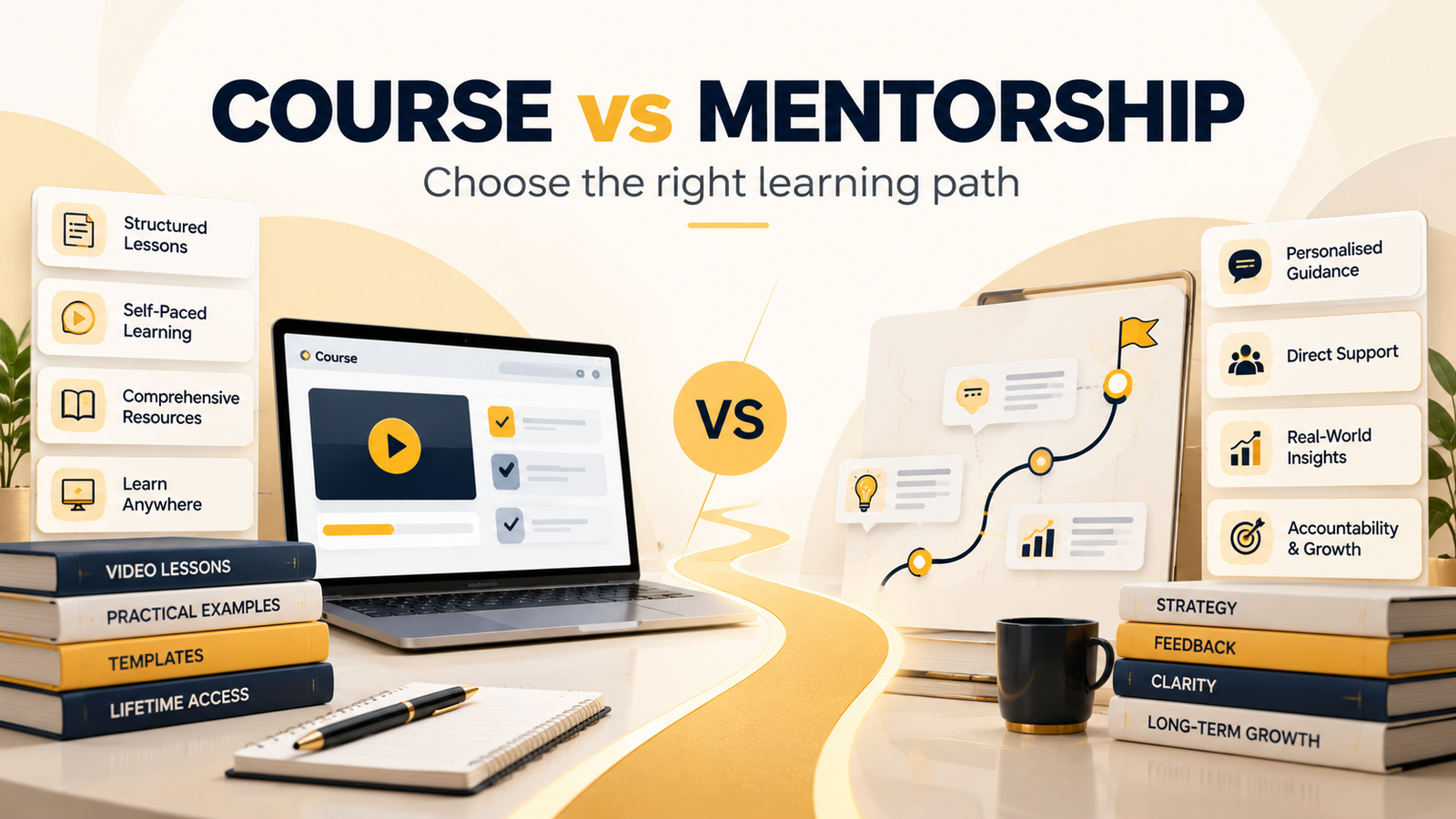
Choosing how to learn a new skill can be just as important as choosing which skill to learn. With so many online courses, video tutorials, learning communities, and mentorship programmes available in 2026, beginners often face one important question: Should you learn through an online course or work with a mentor?
Both options can help you develop digital skills, improve your knowledge, and work towards your career goals. However, they offer different learning experiences, levels of guidance, and approaches to solving problems.
The right choice depends on your current skill level, learning style, available time, budget, and the amount of support you need.
In this guide, we will compare online courses and mentorship, explain the advantages and limitations of each, and help you decide which learning path suits your goals.
What Is an Online Course?
An online course is a structured learning programme that teaches a particular subject through recorded videos, live classes, reading materials, practical exercises, assignments, or assessments.
For example, you might enrol in a course covering digital marketing, social media management, website development, video editing, content writing, or search engine optimisation.
Most online courses follow a planned curriculum, allowing learners to progress through lessons in a logical order.
Benefits of online courses
1. Learn at your own pace
Recorded courses allow you to study according to your schedule. You can pause lessons, revisit difficult concepts, and review material whenever necessary.
2. Follow a structured curriculum
A well-organised course helps you understand what to learn first and which concepts to study next, reducing the confusion that often comes with learning from random online videos.
3. Develop foundational knowledge
Courses are particularly useful when you are starting from scratch and need to understand terminology, tools, processes, and fundamental concepts.
4. Revisit lessons when needed
Having access to learning materials can make revision easier, especially when you are practising a technical skill or completing a project.
5. Study alongside other commitments
Students, employees, entrepreneurs, and people with family responsibilities may find self-paced learning easier to fit into their routines.
Limitations of online courses
An online course may not automatically solve every learning challenge.
- You might struggle to apply a concept to your own situation.
- You may not receive individual feedback on your work.
- Recorded lessons may not address the specific problem you encounter.
- Without a clear practice routine, you may consume content without developing practical ability.
- If you lose motivation, it can be difficult to maintain consistent progress independently.
These limitations do not mean online courses are ineffective. They mean that learning materials alone may not provide every form of support a learner needs.
What Is Mentorship?
Mentorship is a learning relationship in which a more experienced person provides guidance to help someone develop skills, make informed decisions, solve problems, and work towards specific goals.
Unlike a course that primarily delivers educational content, mentorship can involve discussing your current situation, reviewing your progress, identifying mistakes, and deciding what to do next.
In digital marketing or online business, a mentor might help you evaluate your content strategy, improve a portfolio, understand campaign performance, organise client outreach, or develop a more practical learning plan.
The exact experience depends on the mentor and the programme. Some offer individual sessions, while others provide group discussions, feedback, accountability, or community support.
Benefits of mentorship
1. Guidance based on your situation
A mentor may help you connect general concepts with the challenges you are actually facing, rather than asking you to work through every problem alone.
2. Feedback on practical work
Depending on the arrangement, you may receive feedback on projects, proposals, marketing campaigns, content, or other work you create.
Constructive feedback can help you identify weaknesses that are difficult to notice when learning independently.
3. Help with decision-making
Beginners often spend too much time deciding which skill to learn, which tools to use, or which project to attempt next. Mentorship can help bring structure to these decisions.
4. Accountability and consistency
Regular progress reviews or discussions may encourage you to follow through on your learning goals.
5. Support with real-world challenges
A mentor can help you think through unfamiliar situations, understand possible solutions, and learn from practical examples. However, good mentorship should build your own judgement rather than make every decision for you.
Limitations of mentorship
Mentorship also has limitations that deserve consideration.
- The quality of guidance depends on the mentor’s actual expertise and teaching ability.
- Personal guidance requires time and active participation.
- The amount of individual attention varies between programmes.
- A mentor cannot guarantee employment, clients, business growth, or income.
- Mentorship is less useful when learners expect someone else to do the work for them.
Before choosing a mentor, check the programme structure, support arrangements, relevant experience, and expectations for both sides.
Online Course vs Mentorship: Key Differences
The following comparison highlights the typical differences. Actual experiences vary depending on the course or mentorship programme.
| Factor | Online Course | Mentorship |
|---|---|---|
| Main purpose | Deliver structured learning content | Guide learning and practical development |
| Learning approach | Lessons, modules, and exercises | Discussion, feedback, and guided action |
| Flexibility | Often highly flexible | Depends on meeting schedules and support |
| Personalisation | Usually follows a common curriculum | May adapt to your individual needs |
| Feedback | Depends on assignments and course support | May include personalised feedback |
| Problem-solving | Often requires independent effort | Can include discussion of specific challenges |
| Accountability | Primarily self-managed | May include progress reviews |
| Best suited for | Building foundational knowledge | Applying knowledge and addressing individual challenges |
The important distinction is not that one option is universally better. It is whether you need structured content, personalised guidance, or a combination of both.
Which Is Better for Beginners?
If you are completely new to digital marketing, freelancing, or online business, start by identifying what you need most.
Choose an online course if:
- You have little or no knowledge of the subject.
- You prefer learning independently.
- You need a clear sequence of lessons.
- You can maintain a consistent practice routine.
- You are comfortable researching solutions when you encounter difficulties.
For example, someone learning social media marketing could begin with a structured course covering audience research, content planning, platform features, analytics, and campaign fundamentals.
Consider mentorship if:
- You already understand the basics but feel stuck.
- You need feedback on practical projects.
- You are struggling to prioritise the next steps.
- You want help evaluating your approach and correcting mistakes.
- You benefit from discussion, accountability, and personalised direction.
For example, a learner who understands social media marketing but struggles to build a portfolio or plan a client campaign may benefit from practical feedback and guidance.
A useful principle: Learn the fundamentals first, then identify the specific problems you need help solving. You can use that information to decide whether independent learning is sufficient or whether additional guidance would be valuable.
Can You Combine Online Courses and Mentorship?
Yes. For many learners, combining structured education with practical guidance is a sensible approach.
An online course can help you build the knowledge needed to understand a subject, while mentorship may help you apply that knowledge to projects and real-world decisions.
Here is one way to combine the two.
Step 1: Learn the fundamentals
Choose one skill that supports your career or business goals. Work through a structured curriculum instead of switching constantly between unrelated topics.
Step 2: Practise what you learn
Create sample projects, complete exercises, analyse examples, and document your progress.
If you are learning digital marketing, you could create a content calendar, prepare a sample campaign plan, or conduct an SEO audit of a practice website.
Step 3: Identify your knowledge gaps
Review your work and list the specific areas where you need improvement.
For example, you may understand content planning but struggle with analytics, client communication, campaign measurement, or presenting your work professionally.
Step 4: Seek targeted feedback
Use credible learning communities, experienced professionals, peer reviews, or mentorship where appropriate.
Ask specific questions and share the relevant work so that the feedback can address the actual problem.
Step 5: Apply the feedback
Make improvements, test your approach, and compare the results with your original work.
The purpose of guidance is to strengthen your ability to work independently over time.
How to Choose the Right Mentor
If you decide to explore mentorship, evaluate the programme carefully rather than choosing based only on popularity or promotional content.
1. Check relevant experience
Look for evidence that the mentor understands the subject you want to learn. Experience should be relevant to your goals, whether those involve digital marketing, freelancing, content creation, or business development.
2. Understand the support structure
Find out whether the programme includes individual sessions, group calls, written feedback, community discussions, or recorded lessons.
Do not assume that every mentorship programme includes direct, one-to-one support.
3. Look for practical learning
A useful mentorship experience should help you understand how to apply concepts, evaluate decisions, and improve your work—not rely exclusively on motivational discussions.
4. Check expectations and boundaries
Understand how often you can request help, what types of questions are covered, and what work you are expected to complete independently.
5. Evaluate claims critically
Be cautious of anyone promising guaranteed income, instant success, or effortless results. Testimonials can provide context, but individual experiences do not guarantee that you will achieve the same outcome.
6. Confirm the programme details
Read the programme description carefully and clarify the curriculum, access arrangements, duration, support, and applicable terms before making a decision.
Common Mistakes to Avoid When Choosing a Learning Path
Collecting courses without practising
Watching lesson after lesson does not automatically create a marketable skill. Complete projects and apply what you learn.
Expecting a mentor to do the work for you
A mentor can offer direction and feedback, but your progress depends on your own effort, decisions, and practice.
Choosing based only on price or popularity
Consider the quality, relevance, structure, and support of the learning experience rather than relying on a single factor.
Learning too many skills at once
Trying to master SEO, paid advertising, video editing, web development, and copywriting simultaneously can make progress difficult to measure. Start with one primary skill and expand when appropriate.
Confusing motivation with progress
Motivation may help you begin, but consistent practice, feedback, and measurable improvement are more useful indicators of development.
Expecting guaranteed career or financial outcomes
Education can improve your knowledge and capabilities, but results depend on many factors, including execution, experience, market conditions, and available opportunities.
A Practical 30-Day Learning Plan
If you are unsure where to start, use this simple plan to test your learning approach before committing to a more extensive programme.
Days 1–7: Set your direction
- Choose one skill aligned with your goal.
- Identify the foundational concepts you need to learn.
- Select a structured learning resource.
- Set a realistic weekly study schedule.
Days 8–14: Build your foundation
- Complete the relevant lessons.
- Take notes on important concepts.
- Practise each major concept instead of only watching videos.
- Record questions that you cannot resolve independently.
Days 15–21: Create a practical project
- Choose a realistic project related to your skill.
- Apply the concepts you have studied.
- Save examples of your work.
- Identify the areas where you need improvement.
Days 22–30: Review and improve
- Evaluate your project against clear criteria.
- Seek feedback from a knowledgeable person or learning community.
- Correct the weaknesses you identify.
- Decide what to study next.
At the end of the month, review your progress honestly. If your main challenge is a lack of foundational knowledge, continue structured learning. If you understand the fundamentals but need help applying them, targeted feedback or mentorship may be worth exploring.
The goal is not to complete the maximum number of lessons. It is to develop a skill you can demonstrate through practical work.
Frequently Asked Questions
Is an online course better than mentorship?
Neither is always better. Online courses are useful for structured learning, while mentorship can provide personalised guidance and feedback. The better option depends on your needs and current level.
Can I learn digital marketing without a mentor?
Yes. You can learn through courses, documentation, tutorials, experimentation, and independent projects. A mentor is an additional source of guidance, not a universal requirement.
Should I get mentorship before learning the basics?
It depends on the programme and your goals. Many beginners benefit from understanding the fundamentals first, while others may value early guidance to establish a suitable learning direction.
Does mentorship guarantee success?
No. Mentorship can provide direction, feedback, and accountability, but it cannot guarantee employment, clients, business growth, or income.
How do I know whether I need mentorship?
Consider whether you can identify what to learn next, apply concepts independently, evaluate your work, and solve problems as they arise. If you repeatedly struggle with these areas despite consistent effort, additional guidance may be useful.
Can I use free resources instead of paid learning programmes?
Yes. Free tutorials, documentation, articles, and practice projects can help you build substantial knowledge. A paid course or mentorship should be evaluated according to the additional structure, feedback, or support it provides.
Is mentorship useful for experienced learners?
It can be. Experienced learners may seek specialised feedback, help with complex problems, or a fresh perspective on their strategies. The value depends on whether the mentor’s expertise matches the learner’s needs.
Final Thoughts
Choosing between an online course and mentorship is not about finding a single learning method that works for everyone. It is about understanding your current needs and selecting the approach that helps you make meaningful progress.
An online course can provide the structure and foundational knowledge you need. Mentorship can add personalised guidance, feedback, and support when you face challenges that are difficult to resolve independently.
For many people, a combination of both can work well: learn the fundamentals, practise consistently, identify your weaknesses, and seek guidance when it serves a clear purpose.
If you would like to explore digital skills, structured learning, and guidance for your online journey, you can learn more about Sayak Banerjee’s approach on the official website.
- Explore mentorship: https://sayakbanerjee.in/mentorship/
- Discover more articles: https://sayakbanerjee.in/blogs/
- Visit the official website: https://sayakbanerjee.in/
Ultimately, the best learning path is the one that helps you move from consuming information to applying knowledge, improving your skills, and making better-informed decisions.