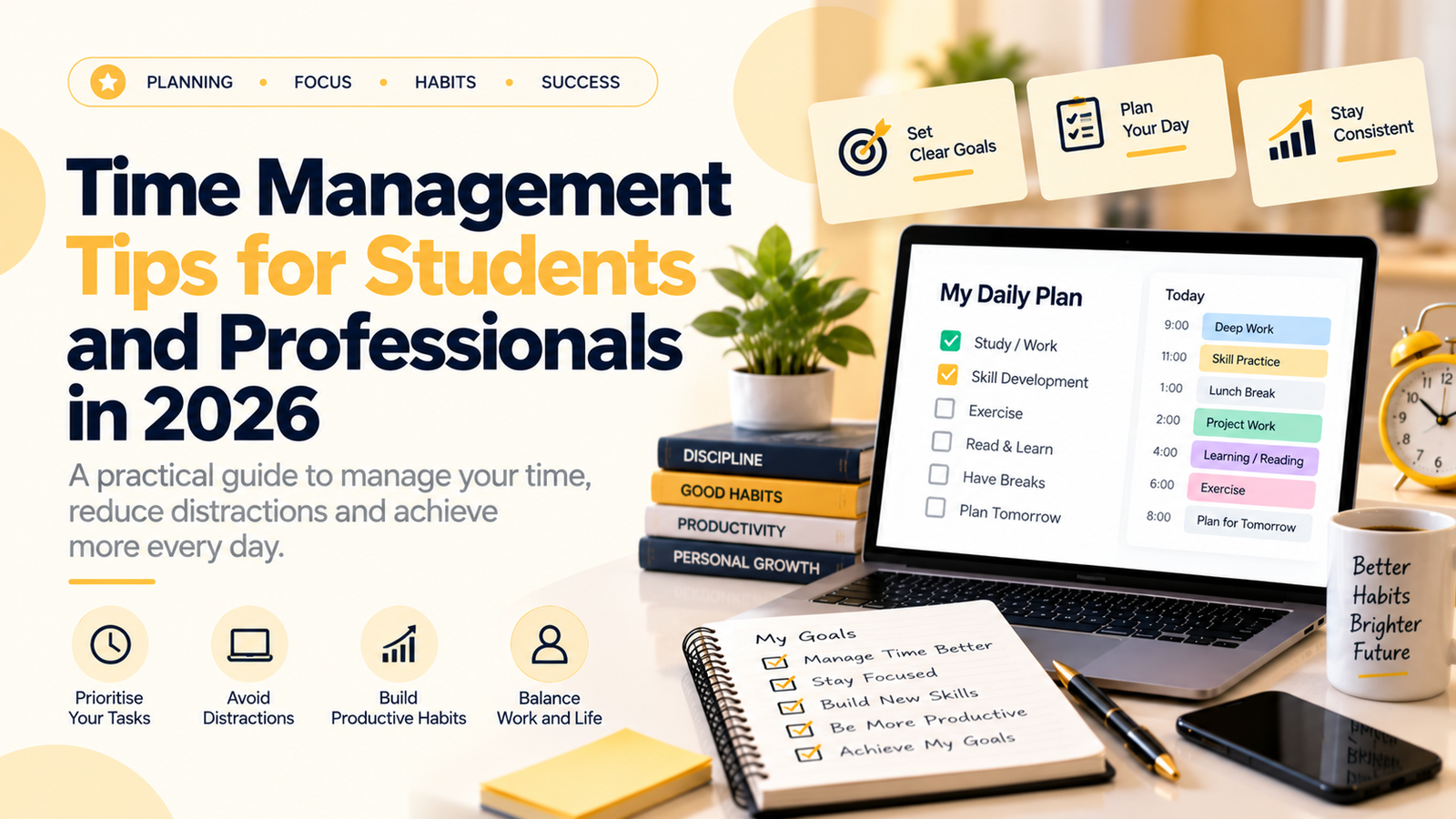
Do you often feel that there are too many things to do and too little time to complete them? Between studies, work, skill development, personal responsibilities, and daily distractions, managing time effectively can become a real challenge.
The solution is not necessarily to work longer hours. It is to use your available time more intentionally, prioritise important tasks, and develop routines that support consistent progress.
Whether you are a student preparing for examinations, a fresh graduate developing professional skills, or a working professional balancing multiple responsibilities, effective time management can help you organise your day and make better use of your energy.
In this guide, we will explore practical time management techniques for 2026, explain how to avoid common productivity mistakes, and develop a realistic routine that you can maintain over time.
1. Understand Where Your Time Goes
Before changing your routine, understand how you currently spend your time.
Many people underestimate the time they lose to unplanned phone use, unnecessary interruptions, switching between tasks, or delaying difficult work.
For a few days, record your main activities and the approximate time spent on each one.
You can use a notebook, spreadsheet, calendar, or task-management application.
Track categories such as:
- Study or professional work.
- Skill development.
- Meetings and communication.
- Social media and entertainment.
- Exercise and personal responsibilities.
- Breaks and rest.
The purpose is not to monitor every minute indefinitely. It is to identify patterns that may be affecting your productivity.
For example, you may discover that you frequently interrupt study sessions to check messages or spend too much time planning without beginning the actual work.
Once you understand the problem, you can make targeted changes instead of adopting an unrealistic routine.
2. Set Clear and Achievable Goals
Time management becomes easier when you know what you are trying to accomplish.
Without clear goals, it is easy to spend an entire day completing small tasks while neglecting the activities that matter most.
Start by defining your priorities at three levels.
Long-term goals
These describe what you want to achieve over several months or years.
Examples include completing a qualification, developing a professional skill, improving academic performance, or preparing for a particular career.
Monthly goals
Break long-term objectives into smaller milestones.
For example, if your goal is to learn digital marketing, a monthly milestone could be completing a foundational module and producing a practical campaign plan.
Daily goals
Identify the specific actions that will move you towards those milestones.
Instead of writing “study digital marketing,” write “complete one lesson and prepare a sample content calendar.”
Specific tasks are easier to begin and evaluate.
Keep your goals realistic. A plan that accounts for your actual responsibilities is more useful than an ambitious schedule that becomes impossible to maintain.
3. Prioritise Tasks Instead of Treating Everything as Urgent
Not every task deserves the same amount of attention.
Some activities have important deadlines or consequences, while others can wait or may not need to be done at all.
A simple method is to divide tasks into four categories.
| Category | Meaning | What to do |
|---|---|---|
| Important and urgent | Requires prompt attention | Handle it first |
| Important but not urgent | Supports long-term progress | Schedule dedicated time |
| Urgent but less important | Needs attention but may not require your direct effort | Simplify, delegate, or limit where appropriate |
| Neither important nor urgent | Provides little value towards your priorities | Reduce or remove |
For a student, preparing for an examination scheduled soon may be urgent and important.
For a professional, completing a critical project deliverable may require immediate attention, while developing a new skill may be important but not urgent.
Do not spend all your time responding to immediate demands. Reserve time for activities that contribute to your longer-term goals.
4. Plan Your Day the Night Before
A short planning session at the end of the day can make the following morning easier.
Write down the tasks you need to complete, identify the most important ones, and decide when you will work on them.
Your plan should include:
- One to three priority tasks.
- Important deadlines or appointments.
- Dedicated study or work periods.
- Breaks and meals.
- Exercise or personal commitments.
- Time to review unfinished work.
Avoid filling every minute with a task.
Unexpected requests, delays, and changes are part of daily life. Leaving some flexibility in your schedule makes it easier to adjust without abandoning the entire plan.
At the end of the day, review what you completed and move unfinished tasks to an appropriate future slot.
5. Use Time Blocking to Organise Your Schedule
Time blocking means assigning specific periods of your day to particular activities.
Instead of keeping a long to-do list and deciding what to do every few minutes, you reserve time for important categories of work.
For example, a student might plan a morning study block, an afternoon practical session, and an evening revision period.
A working professional might reserve time for focused project work, meetings, communication, and skill development.
The schedule should reflect your actual commitments rather than an idealised version of your day.
Example of a simple daily schedule
| Time | Activity |
|---|---|
| 8:00–8:30 AM | Review priorities and prepare |
| 8:30–10:00 AM | Focused study or important work |
| 10:00–10:15 AM | Short break |
| 10:15–11:30 AM | Continue priority work |
| 11:30 AM–12:00 PM | Messages and routine tasks |
| Afternoon | Classes, meetings, projects, or responsibilities |
| Evening | Skill practice, exercise, or revision |
| Before bed | Review progress and plan tomorrow |
This is only an illustration. Adjust the timings according to your classes, working hours, sleep schedule, and personal responsibilities.
Consistency matters more than following someone else’s timetable exactly.
6. Try the Pomodoro Technique
The Pomodoro Technique is a time-management method that divides work into focused sessions separated by short breaks.
A common version involves:
- Choosing one specific task.
- Working with concentration for around 25 minutes.
- Taking a short break.
- Repeating the process.
- Taking a longer break after several sessions.
You can adapt the session length to the task. Some people prefer longer blocks for writing, coding, reading, or complex problem-solving.
The main principle is to create a clear boundary between focused work and distractions.
For example, during a study session, keep your phone away, close unrelated browser tabs, and work on one defined objective.
If a task requires uninterrupted concentration for longer periods, adjust the method rather than forcing yourself to stop at an arbitrary time.
7. Reduce Digital Distractions
Digital distractions can fragment your attention and make simple tasks take longer than necessary.
Notifications, social media feeds, messaging applications, and frequent browsing can interrupt your concentration.
You do not need to eliminate technology from your life. You need to use it deliberately.
Practical ways to reduce distractions
Turn off unnecessary notifications. Keep alerts for genuinely important communications and disable those that frequently interrupt your work.
Keep your phone away during focused sessions. Place it out of reach or use a focus setting when practical.
Set specific times for messages. Instead of checking every new notification, review messages during planned breaks.
Use website or app restrictions if helpful. Choose tools that temporarily limit access to distracting services.
Keep your workspace organised. Remove unnecessary items and prepare the materials you need before beginning.
Avoid unnecessary multitasking. Switching repeatedly between unrelated tasks can make it harder to maintain focus.
Start by changing one or two habits rather than attempting to redesign your entire digital routine overnight.
8. Develop the Habit of Starting Difficult Tasks
Procrastination often occurs when a task feels overwhelming, unclear, boring, or uncomfortable.
You may know what needs to be done but still delay starting it.
One useful approach is to reduce the size of the first action.
Instead of telling yourself to complete an entire assignment, begin by opening the document and writing the outline.
Instead of trying to master a complete subject, study one concept and solve a few practice questions.
Instead of building an entire portfolio in one day, select one project and define its scope.
Use the five-minute starting rule
Commit to working on the task for just five minutes.
The goal is to make starting easier, not to force yourself to finish everything immediately.
Once you begin, you may find it easier to continue. If you still struggle, examine whether the task is too large, unclear, or competing with another important responsibility.
Breaking work into smaller steps helps turn vague intentions into concrete actions.
9. Match Difficult Work to Your Energy
Your available time is important, but your energy and concentration also affect how effectively you use it.
Some people feel most alert in the morning, while others work better later in the day.
Notice when you tend to concentrate best and schedule demanding tasks during those periods when possible.
For example:
- Use your strongest concentration period for difficult study or analytical work.
- Handle routine administration during lower-energy periods.
- Take short breaks when your attention begins to decline.
- Avoid scheduling demanding tasks back-to-back without recovery time.
- Protect adequate sleep and regular meals.
Do not assume that waking up extremely early is necessary for productivity. A routine that fits your natural pattern and responsibilities is more sustainable than one that repeatedly leaves you exhausted.
10. Learn to Say No and Set Boundaries
Taking on too many responsibilities can make even a well-organised schedule ineffective.
You may need to decline unnecessary commitments, renegotiate deadlines, or limit activities that do not align with your priorities.
Before agreeing to a new task, consider:
- How much time will it require?
- Is it genuinely important?
- Does it conflict with an existing commitment?
- Can the deadline be adjusted?
- Is there a simpler way to complete it?
Setting boundaries does not mean refusing every request.
It means being realistic about your capacity and communicating clearly when you cannot take on additional work without affecting existing responsibilities.
For students, this may involve balancing extracurricular activities with academic deadlines. For professionals, it may mean clarifying priorities when several projects compete for attention.
11. Use Digital Tools to Support Your Routine
You do not need a large collection of productivity applications to manage your time effectively.
A calendar, a simple task list, and a timer may be enough.
Depending on your needs, you could explore:
- <Entity value=”Google Calendar” category=”software” disambig=”Calendar and scheduling application”/> for scheduling events and time blocks.
- <Entity value=”Notion” category=”software” disambig=”Workspace for notes, documents, databases, and project management”/> for organising notes, projects, and recurring tasks.
- <Entity value=”Todoist” category=”software” disambig=”Task and to-do list management application”/> for maintaining task lists and deadlines.
- A basic timer for focused work sessions.
- A notebook or spreadsheet for weekly planning.
Choose tools based on the problem you need to solve.
If your task list is already manageable on paper, you may not need another application.
Avoid spending more time designing elaborate productivity systems than actually completing your work.
12. Balance Productivity With Rest and Personal Life
Effective time management is not about working continuously.
Rest, sleep, exercise, relationships, and personal activities are important parts of a sustainable routine.
Without sufficient recovery, concentration may decline and tasks may take longer than expected.
Make room for:
- Adequate sleep.
- Regular meals.
- Physical activity suited to your circumstances.
- Breaks during extended work sessions.
- Time with family and friends.
- Leisure and activities that help you recharge.
If you consistently feel overwhelmed, review your total workload rather than assuming that you simply need a stricter schedule.
Sometimes the best productivity decision is to reduce unnecessary commitments, seek help, or adjust unrealistic expectations.
13. Review Your Progress Every Week
A weekly review helps you understand whether your schedule is supporting your goals.
Choose a regular time to look back at the previous week and prepare for the next one.
Ask yourself:
- Which important tasks did I complete?
- What repeatedly distracted me?
- Which activities took longer than expected?
- Did I allocate enough time to my priorities?
- What should I stop, start, or change next week?
- Which unfinished tasks genuinely need to continue?
Use your answers to make small adjustments.
If a task repeatedly remains unfinished, break it into smaller steps or assign it a more realistic time slot.
If your schedule feels too crowded, remove or postpone lower-priority activities where possible.
A weekly review should help you learn from experience, not become another complicated task that consumes your time.
14. A Practical 30-Day Time-Management Plan
If you want to improve your routine, start with a simple four-week plan.
Week 1: Understand your habits
- Record your main activities.
- Identify frequent distractions.
- Note when you concentrate best.
- List your most important responsibilities.
- Choose one habit to improve.
Week 2: Build a planning system
- Write your daily priorities.
- Try time blocking.
- Break large tasks into smaller actions.
- Schedule realistic breaks.
- Review your plan at the end of each day.
Week 3: Improve focus
- Experiment with focused work sessions.
- Reduce unnecessary notifications.
- Keep your workspace prepared.
- Practise starting difficult tasks.
- Adjust your schedule to your energy levels.
Week 4: Review and refine
- Evaluate your completed tasks.
- Identify which techniques helped.
- Remove unnecessary steps from your routine.
- Set priorities for the next month.
- Continue the habits that are practical and sustainable.
You do not need to follow every technique perfectly. The objective is to discover which methods work for your circumstances and build a routine that you can maintain.
Frequently Asked Questions
What is the best time-management technique for students?
There is no single technique that works for everyone. Planning daily priorities, breaking assignments into smaller steps, time blocking, and focused study sessions are useful starting points.
How can working professionals manage multiple tasks?
Identify the most important deliverables, schedule focused work, group routine tasks where practical, communicate deadlines clearly, and review priorities when new requests arise.
Does multitasking improve productivity?
For many demanding tasks, frequently switching between activities can reduce concentration and increase the chance of mistakes. Focusing on one priority at a time is often more effective.
How can I stop procrastinating?
Make the first step smaller, clarify the task, remove distractions, and set a realistic starting time. If procrastination continues, examine whether the task is unclear, overwhelming, or affected by other difficulties.
Are productivity apps necessary?
No. A paper notebook, calendar, or simple checklist may be sufficient. Use an application only when it solves a specific organisational problem.
How long does it take to develop better time-management habits?
It varies. Some changes may help immediately, while consistent habits usually require repeated practice and adjustment. Focus on sustainable progress rather than expecting instant perfection.
Should I follow a strict timetable every day?
A timetable can provide structure, but it should allow flexibility for unexpected events, changing priorities, and personal responsibilities. A realistic schedule is usually more sustainable than one that leaves no room for adjustment.
Final Thoughts
Time management is not about filling every hour with work or trying to become productive at all times.
It is about understanding your priorities, making deliberate choices, protecting your attention, and creating routines that support your goals without ignoring your well-being.
Start by observing how you spend your time. Choose a few important tasks, plan realistic work periods, reduce unnecessary distractions, and review your progress regularly.
Small improvements can become valuable habits when you practise them consistently.
The objective is not to do everything in one day. It is to use your time intentionally so that the work that matters receives the attention it deserves.
If you want to continue developing your digital skills, professional habits, and learning approach, explore more resources through Sayak Banerjee’s official website.
- Explore mentorship: https://sayakbanerjee.in/mentorship/
- Read more articles: https://sayakbanerjee.in/blogs/
- Visit the official website: https://sayakbanerjee.in/
Choose one habit to improve today, practise it consistently, and adjust your routine as you learn what works best for you.