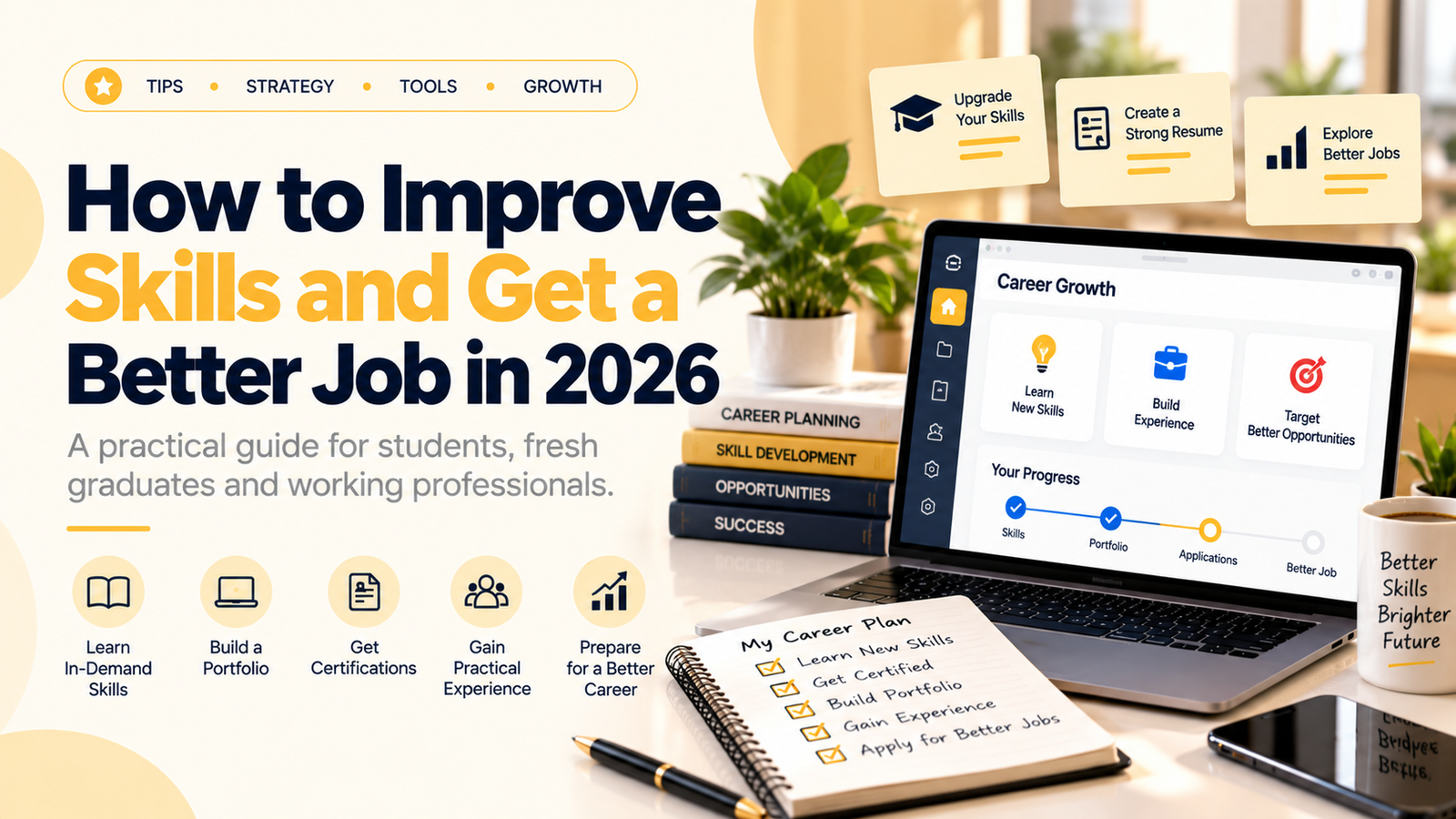
The job market is changing rapidly, and having a degree alone may not always be enough to stand out among other candidates. Employers increasingly look for relevant skills, practical experience, problem-solving ability, communication, and evidence that candidates can apply what they know.
For students, fresh graduates, and working professionals, improving employability requires a clear plan. You need to identify the skills relevant to your career, practise them, demonstrate your abilities, and prepare effectively for opportunities.
The good news is that you do not need to learn everything at once. A focused approach can help you make steady progress while balancing your studies, work, or other responsibilities.
In this guide, we will explore how to improve your skills in 2026, build a stronger professional profile, gain practical experience, and prepare for better career opportunities.
1. Understand What Employers Need
Before enrolling in a course or collecting certificates, understand the requirements of the roles you want to pursue.
Different careers demand different combinations of knowledge and practical abilities. A digital marketer may need to understand content strategy, analytics, and campaign planning. A software developer may need programming knowledge, debugging skills, and the ability to work with development tools.
Start by reviewing job descriptions for roles that interest you.
Look for recurring requirements, including:
- Technical or role-specific skills.
- Communication and collaboration.
- Practical project experience.
- Problem-solving and analytical thinking.
- Familiarity with relevant tools.
- Professional writing and presentation.
- Industry-specific knowledge or certifications.
Create a list of the skills you already have and those you need to develop.
This exercise helps you avoid spending time on unrelated courses and gives you a clearer direction for your learning.
2. Choose One Primary Skill to Develop
Trying to learn too many skills simultaneously can make progress difficult to measure.
Instead, choose one primary skill that aligns with your career objective. You can add complementary skills after developing a reasonable foundation.
For example:
For digital marketing
- SEO and keyword research.
- Social media strategy.
- Content marketing.
- Paid advertising fundamentals.
- Marketing analytics.
For technology
- Programming fundamentals.
- Web development.
- Data analysis.
- Database concepts.
- Software testing.
For business and management
- Business communication.
- Spreadsheet analysis.
- Project coordination.
- Market research.
- Presentation and reporting.
For creative careers
- Graphic design.
- Video editing.
- Content writing.
- UI/UX fundamentals.
- Visual storytelling.
You do not need to master every skill in your chosen field immediately. Focus on developing one useful capability and learning how it is applied in professional settings.
3. Build Practical Skills Instead of Only Watching Tutorials
Learning concepts is important, but employability also depends on your ability to apply them.
For example, watching a video about SEO does not automatically mean you can perform an SEO audit. Studying graphic design principles does not necessarily mean you can create a professional campaign visual.
Use a learn-practise-review cycle.
Step 1: Learn the fundamentals
Choose a structured resource and understand the basic concepts.
Step 2: Apply what you learn
Complete a small project related to the skill.
Step 3: Review your work
Identify mistakes, missing elements, and opportunities to improve.
Step 4: Repeat with a more challenging task
Gradually increase the complexity of your projects as your confidence develops.
This approach helps you move beyond passive learning and build skills that you can demonstrate.
4. Build a Portfolio That Shows What You Can Do
A portfolio is a collection of work that demonstrates your abilities.
It can be useful for students, fresh graduates, freelancers, and professionals who want to transition into a different role.
You do not always need paid work to build a portfolio. You can begin with independent projects, sample assignments, demonstrations, or concept work.
Examples of portfolio projects
Digital marketing: Create a sample content calendar, keyword research report, or campaign plan.
Web development: Build a simple website or application that demonstrates your technical abilities.
Data analysis: Analyse a suitable dataset and present your findings with charts and explanations.
Graphic design: Prepare a small collection of related designs for a fictional brand.
Content writing: Write a few high-quality articles or create sample website copy.
Business analysis: Prepare a market research report or a structured case study.
Explain the objective of each project, your approach, the tools you used, and what you learned.
Be transparent about whether the project was completed for a real client or created for practice. Never present sample work as paid professional experience.
A focused portfolio can help employers understand your capabilities more clearly than a long list of unrelated courses.
5. Choose Certifications Strategically
Certifications can help demonstrate knowledge in certain fields, but their value depends on the role, the issuing organisation, and the skills they assess.
Before enrolling in a certification programme, consider:
- Is the certification relevant to your target role?
- Is it recognised or valued in your industry?
- Does it test practical knowledge or primarily theoretical concepts?
- Will the learning help you complete useful projects?
- Does the time and cost make sense for your current goals?
Some careers require specific qualifications, licences, or examinations. In other fields, employers may place greater emphasis on demonstrated ability and relevant experience.
Avoid collecting certificates simply to make your résumé longer.
A smaller number of relevant credentials, supported by practical projects and a clear understanding of the subject, may be more useful than a large collection with little connection to your target role.
6. Improve Your Communication Skills
Technical ability is important, but communication can also influence how effectively you work with colleagues, clients, managers, and interviewers.
Professional communication includes more than speaking confidently. It also involves listening carefully, writing clearly, asking relevant questions, and explaining your reasoning.
Skills worth developing
Written communication: Practise writing clear emails, reports, proposals, and professional messages.
Verbal communication: Learn to explain ideas in a structured and understandable way.
Active listening: Pay attention to requirements before deciding how to respond.
Presentation skills: Practise explaining projects, findings, and recommendations.
Collaboration: Learn to give constructive feedback, accept suggestions, and work towards shared objectives.
You can practise these skills through presentations, group projects, mock interviews, and written summaries of what you learn.
Communication improves with repeated practice, feedback, and reflection.
7. Learn to Use AI and Digital Tools Responsibly
AI tools and digital platforms can support learning and workplace productivity.
Depending on the task, they may help you brainstorm ideas, organise notes, draft content, analyse information, prepare presentations, or understand technical concepts.
However, using a tool is not the same as developing expertise.
To get the most value from AI:
- Understand the task before asking for assistance.
- Provide clear instructions and relevant context.
- Review the generated output.
- Verify important facts and calculations.
- Protect confidential or sensitive information.
- Practise the underlying skill independently.
For example, a student can use an AI assistant to understand a programming concept and then write and test the code independently.
A marketing professional can use AI to brainstorm campaign ideas but should still evaluate the target audience, business objectives, accuracy, and suitability of the final campaign.
Employers value people who can use tools thoughtfully and take responsibility for their work.
8. Gain Experience Before You Feel Completely Ready
Many beginners delay applying for opportunities because they believe they need to master every skill first.
Although preparation matters, waiting until you feel completely ready can prevent you from gaining practical experience.
Look for appropriate ways to practise in realistic settings.
These may include:
- Academic or personal projects.
- Internships.
- Apprenticeships or structured training opportunities.
- Volunteer projects with clear responsibilities.
- Entry-level assignments.
- Collaborative projects.
- Relevant work within your current organisation.
Choose opportunities that allow you to learn, produce useful work, and receive feedback.
Understand the responsibilities, working conditions, and expectations before accepting an opportunity. If a role is unpaid or involves a trial assignment, evaluate the arrangement carefully and consider the applicable rules.
The goal is to develop experience that strengthens your abilities and helps you understand how professional work is performed.
9. Create a Strong Résumé and Professional Profile
Your résumé should make it easy for a recruiter or hiring manager to understand your qualifications and relevance to the role.
A strong résumé does not need to be unnecessarily complicated.
Include the essentials
- Contact information.
- A concise professional summary, where useful.
- Education and relevant qualifications.
- Technical and professional skills.
- Projects and relevant experience.
- Certifications related to the role.
- Links to your portfolio or professional profile.
Tailor your résumé to the position
Read the job description and identify the most relevant requirements.
Then make sure your résumé accurately highlights your matching skills, projects, and experience.
For example, if a role involves data analysis, your project descriptions should explain the data you worked with, the tools you used, and the conclusions you produced.
Do not copy keywords into your résumé if they do not reflect your actual capabilities.
Where you can substantiate results, describe them clearly. If you do not have measurable outcomes, explain the work you completed and the skills you applied instead of inventing numbers.
Keep your professional profile consistent with the information in your résumé.
10. Build a Professional Network
Networking is not simply about collecting contacts. It is about developing genuine professional relationships and learning about your field.
You can start by connecting with:
- Classmates and alumni.
- Teachers and mentors.
- Professionals in your target industry.
- People working in roles you want to explore.
- Participants in relevant events and communities.
- Colleagues and collaborators.
Use professional platforms such as <Entity value=”LinkedIn” category=”software” disambig=”Professional networking platform”/> to follow industry discussions, learn about career paths, and share relevant work.
When contacting someone, introduce yourself clearly and explain why you are reaching out. Ask thoughtful questions rather than immediately requesting a job or referral.
You can also build relationships by sharing useful project updates, participating in discussions, and helping others where appropriate.
Networking does not guarantee employment, but it can help you understand opportunities, improve your professional awareness, and develop meaningful connections.
11. Prepare for Interviews With Practice
A strong résumé may help you get noticed, but interviews often require you to explain your skills, experience, and approach to problem-solving.
Prepare for interviews by researching the organisation, understanding the role, and practising answers to likely questions.
Questions to practise
- Tell me about yourself.
- Why are you interested in this role?
- Which skills make you suitable for the position?
- Describe a project you completed.
- What challenge did you face, and how did you handle it?
- What are you currently learning?
- How do you respond to feedback or mistakes?
For experience-based questions, use a clear structure:
Situation: Explain the context.
Task: Describe your responsibility.
Action: Explain what you did.
Result: Describe the outcome or what you learned.
If you are a beginner, you can discuss academic assignments, personal projects, or other relevant experiences. Be honest about your level of responsibility and contribution.
For technical roles, practise the relevant tasks rather than relying only on memorised answers.
12. Build a Learning Routine You Can Maintain
Career development does not always require studying for several hours every day. The key is to create a realistic routine and follow it consistently.
A simple weekly plan might include:
- Dedicated time for learning new concepts.
- Practical work related to your primary skill.
- Time to review and improve projects.
- Résumé or portfolio updates when needed.
- Career research and networking.
- Interview practice where relevant.
Adjust the routine according to your responsibilities, energy, and current goals.
It is also important to review your progress. If you have spent several weeks studying but have not completed a project or practised the skill, change your approach.
Learning should gradually produce stronger understanding and practical ability.
13. A 30-Day Plan to Improve Your Career Readiness
If you are unsure where to start, use this plan as a foundation.
Week 1: Assess your skills
- Identify the role or career direction you want to explore.
- Review relevant job descriptions.
- List the skills you already have.
- Identify two or three important gaps.
- Select one primary skill to develop.
Week 2: Learn and practise
- Choose a suitable learning resource.
- Study the fundamentals.
- Complete small practical exercises.
- Review mistakes and clarify difficult concepts.
- Record your progress.
Week 3: Build evidence of your ability
- Complete a relevant project.
- Document your approach and decisions.
- Ask for feedback where possible.
- Improve the project based on that feedback.
- Add the work to your portfolio if appropriate.
Week 4: Prepare for opportunities
- Update your résumé.
- Improve your professional profile.
- Practise explaining your project.
- Research suitable roles or internships.
- Begin applying to relevant opportunities.
- Identify the next skill or project to develop.
At the end of 30 days, review what you have learned, what you can demonstrate, and which areas still need work.
You may not become fully job-ready in every field within a month. The purpose is to establish a focused process that you can continue improving.
14. Common Career Development Mistakes to Avoid
Learning without a clear objective
Choose skills that connect to a realistic career direction rather than following every trend.
Collecting certificates without practical work
Use what you learn to complete projects and demonstrate your understanding.
Waiting until you feel completely ready
Apply for suitable opportunities when you meet the essential requirements and are prepared to learn.
Ignoring communication skills
Practise explaining your work, writing clearly, and collaborating with others.
Using a generic résumé for every application
Tailor your résumé to the role while keeping every claim accurate.
Expecting instant results
Career development involves learning, practice, applications, feedback, and adjustment. Progress may take longer than expected.
Misrepresenting experience
Never invent qualifications, projects, job titles, or achievements. Credibility is essential for long-term professional growth.
Frequently Asked Questions
Which skills should I learn in 2026 to improve my job prospects?
The right skills depend on your target role and industry. Review relevant job descriptions, identify recurring requirements, and prioritise the capabilities that connect directly to your goals.
Are certifications enough to get a job?
Certifications can demonstrate relevant knowledge, but they do not guarantee employment. Practical ability, communication, experience, and suitability for the role may also matter.
Can fresh graduates get jobs without experience?
Some entry-level roles are designed for candidates with limited professional experience. Relevant projects, internships, practical assignments, and demonstrated skills can help you present your capabilities.
How can I improve my skills while working full-time?
Create a realistic routine around your existing responsibilities. Focus on one priority skill, use short but consistent learning sessions, and apply what you learn through practical projects.
Should I learn AI tools for my career?
AI literacy can be useful in many fields, but its importance varies by role. Focus on understanding how relevant tools support your work while developing the underlying professional skills.
How long does it take to become job-ready?
There is no universal timeline. It depends on your starting point, the role, the complexity of the required skills, and the time you can dedicate to learning and practice.
Final Thoughts
Improving your career prospects in 2026 is not about learning every available skill or collecting as many certificates as possible.
It is about making deliberate choices, developing relevant capabilities, practising consistently, and demonstrating what you can do.
Start by understanding the roles you want to pursue. Identify the skills that matter, practise them through real projects, improve your communication, and prepare your professional profile for suitable opportunities.
Review your progress regularly and adjust your learning plan as your goals and the market evolve.
A stronger career is built through a combination of knowledge, practical ability, professional behaviour, and the willingness to keep learning.
If you want to explore digital skills, professional development, and online learning, you can find more resources through Sayak Banerjee’s official website.
- Explore mentorship: https://sayakbanerjee.in/mentorship/
- Read more articles: https://sayakbanerjee.in/blogs/
- Visit the official website: https://sayakbanerjee.in/
Choose one meaningful goal, take the first practical step, and build on your progress consistently.